Matcha vs Green Tea: What's the Difference?
Same plant, very different cups. How matcha and green tea are grown, made, brewed and enjoyed, plus how to choose between them.

Matcha vs green tea is one of the questions we hear most, and the answer starts with a surprise: they come from the same plant. Both are made from Camellia sinensis. What sets them apart is how the leaves are grown, processed and brewed, and those choices add up to two very different cups.
How matcha is made
Matcha starts in the shade. For several weeks before harvest, farmers in Japan cover the tea bushes, which slows their growth and deepens the green of the leaves. After picking, the leaves are steamed, dried and stripped of their stems and veins. What's left is called tencha, and it's ground slowly into a fine powder, traditionally on stone mills. (Slow is the point here. Nobody's in a hurry.)
Because you whisk the powder into water and drink all of it, you're getting the whole leaf. That's why matcha tastes so rich and looks so vivid.
How green tea is made
Most green tea grows in full sun. After picking, the leaves are heated quickly to stop oxidation. Japanese green teas such as sencha are usually steamed, which gives them a grassy, oceanic freshness. Chinese green teas are usually pan-fired, which brings out nutty, toasty notes. Think of the chestnut sweetness of Xi Hu Long Jing.
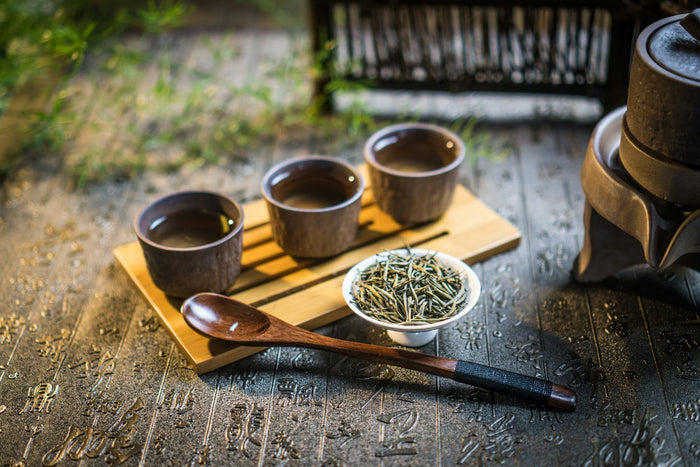
With green tea, you steep the leaves and then take them out. You drink the infusion, not the leaf.
Matcha vs green tea at a glance
| Matcha | Green tea | |
|---|---|---|
| Growing | Shade-grown before harvest | Usually sun-grown |
| Form | Fine powder | Whole or cut leaves |
| Preparation | Whisked into water | Steeped, then strained |
| Flavor | Creamy, rich, savory (umami) | Light, grassy, nutty or floral |
| Caffeine per cup | Usually higher, since you drink the leaf | Usually lower |
| Origin | Mostly Japan | Japan, China, Korea, Nepal and beyond |
What does matcha taste like?
Good matcha is smooth, sweet and savory, with a velvety body and a gentle bitterness at the finish. Lower grades meant for baking taste sharper. If matcha has ever reminded you of lawn clippings, don't give up on it yet. You probably had a culinary grade, or too much powder in too little water.
What does green tea taste like?
Green tea covers a lot of ground. Japanese sencha can taste like fresh snap peas and sea air. Chinese pan-fired greens lean toward roasted chestnut. Nepalese greens such as Himalayan Mist can be floral and bright. Roasted Japanese greens like hojicha are toasty and low in bitterness.
How to prepare each one
Matcha
- Sift about 1 to 2 grams (half to one teaspoon) of matcha into a bowl.
- Add 2 to 3 ounces of water around 175°F.
- Whisk briskly in a W or M motion until a fine foam forms, about 15 to 20 seconds. Your wrist will get the hang of it.
A proper bamboo whisk makes a real difference. Our handmade matcha bowls and whisk sets turn the ritual into a little daily pleasure.
Green tea
Use about one teaspoon of leaves per 8 ounces of water at 160 to 180°F. Steep for 1 to 3 minutes, then take the leaves out. Our loose leaf brewing guide has more detail.
Which should you choose?
Go for matcha if you love a rich, creamy cup with a bit of ceremony, or if lattes are your thing. Go for green tea if you want something lighter to sip all afternoon and steep again and again. Plenty of tea lovers keep both on the shelf, and we think that's the right answer. Explore our matcha and green tea collections to find your favorite.
Quick answers
Is matcha just powdered green tea?
Not quite. Matcha is made from shade-grown leaves processed specifically for grinding. Grinding up ordinary green tea won't give you the same flavor or color.
Does matcha have more caffeine than green tea?
Usually, yes, because you drink the whole leaf. The exact amount depends on how much powder you use.
Can I make matcha without a whisk?
You can shake it in a jar or use a small frother. A bamboo whisk still gives the smoothest foam.